What are the Judgements in the Bible?
The Timeline of Divine Justice
“For we must all appear before the judgment seat of Christ; that every one may receive the things done in his body, according to that he hath done, whether it be good or bad.” — 2 Corinthians 5:10
A biblically based theological definition of the “Judgments” refers to the specific, appointed times in God’s redemptive timeline where He, as the Sovereign Creator and Righteous Judge, evaluates the works, faith, and spiritual state of angels and humanity. Far from a single event, biblical eschatology and historical theology reveal a chronological series of judgments . Each judgment has a distinct time, purpose, and subject, ultimately serving to eradicate sin, reward righteousness, and establish God’s eternal Kingdom.
For the growing Christian disciple, understanding these judgments is not meant to instill paralyzing fear, but to foster a reverent awe, inspire holy living, and cultivate an urgent passion for the Great Commission.
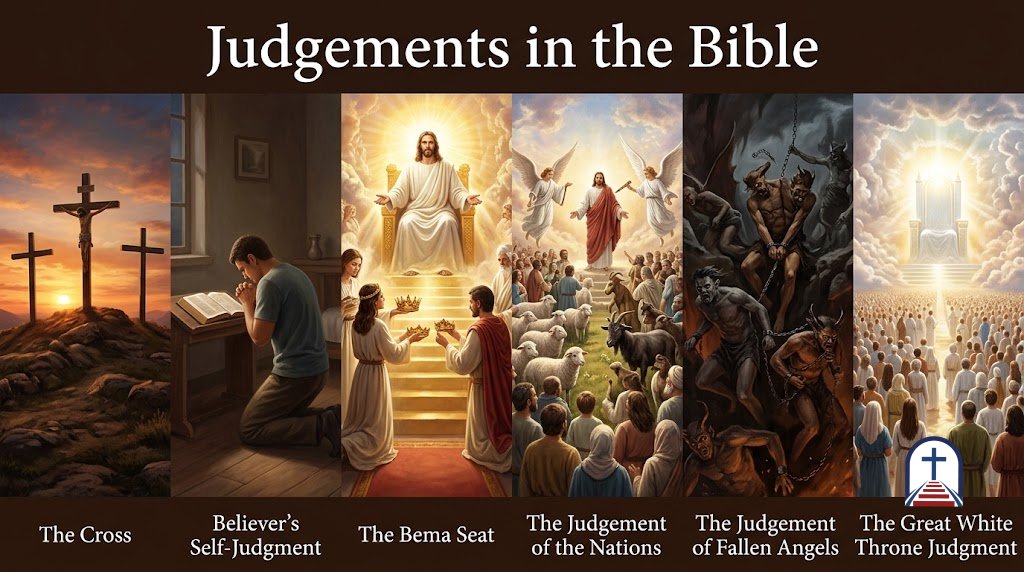
1. The Judgment of Sin at the Cross (Past)
The foundation of the Christian faith rests upon the historical reality that the ultimate judgment for sin has already occurred .
- Time: Approximately 33 A.D. at Calvary.
- Who is Being Judged: Jesus Christ, acting as the substitutionary lamb for the sins of the world.
- Description and Purpose: God’s perfect justice demands that sin be punished by death (Romans 6:23). Instead of pouring this wrath out on humanity, God placed the sins of the world upon Jesus Christ. He bore our griefs and carried our sorrows, being wounded for our transgressions (Isaiah 53:5).
- Outcome: The penalty for sin was fully paid. Christ declared, “It is finished” (John 19:30). For those who place their faith in Christ, their sins are judged at the cross, resulting in justification and freedom from the eternal penalty of sin (Romans 8:1).
2. The Believer’s Self-Judgment (Present)
While believers are free from the eternal penalty of sin, they are still called to a life of sanctification and holiness.
- Time: Continually, throughout the believer’s earthly life.
- Who is Being Judged: The individual Christian.
- Description and Purpose: The Apostle Paul writes, “For if we would judge ourselves, we should not be judged” (1 Corinthians 11:31). This is a daily process of introspection, confession, and repentance. It is the work of the Holy Spirit convicting the believer of sin to maintain unhindered fellowship with God (1 John 1:9).
- Outcome: Spiritual growth, sanctification, and divine discipline (chastisement) from a loving Father if the believer refuses to repent (Hebrews 12:5-11).
3. The Judgment Seat of Christ (Future)
Often referred to as the “Bema Seat,” this is an evaluation of believers, not for salvation, but for rewards .
- Time: Following the Rapture and Resurrection of the Church, prior to the Second Coming.
- Who is Being Judged: All resurrected and raptured believers in Christ.
- Description and Purpose: As stated in 2 Corinthians 5:10 and Romans 14:10, all believers must stand before this judgment. Here, the Christian’s earthly works, motives, and faithfulness will be tested by fire (1 Corinthians 3:12-15). It is not a judgment of condemnation, as their salvation was secured at the cross, but an assessment of stewardship.
- Outcome: Works done in the flesh or for selfish glory (wood, hay, stubble) will be burned away, resulting in a loss of potential rewards. Works done in faith and obedience to the Holy Spirit (gold, silver, precious stones) will survive, resulting in eternal rewards and crowns (e.g., the Crown of Righteousness, the Crown of Life) to cast at the feet of Jesus.

4. The Judgment of the Nations (Future)
Also known as the Judgment of the Sheep and the Goats, this event separates the survivors of the Tribulation period.
- Time: At the Second Coming of Christ, immediately preceding the Millennial Kingdom.
- Who is Being Judged: The living nations (Gentiles) who survive the seven-year Tribulation.
- Description and Purpose: Jesus describes this extensively in Matthew 25:31-46. When the Son of Man comes in His glory, He will gather the nations and separate them as a shepherd divides his sheep from the goats. The basis of this judgment is their treatment of Christ’s “brethren” (the Jewish people and Tribulation saints) during the intense persecution of the Antichrist.
- Outcome: The “sheep” (righteous) who demonstrated faith through their compassionate works will inherit the earthly Millennial Kingdom. The “goats” (unrighteous) who rejected God and neglected His people will depart into everlasting fire.
5. The Judgment of Fallen Angels (Future)
The rebellious spiritual beings who aligned with Lucifer will face their final doom.
- Time: At the end of the Millennial Kingdom.
- Who is Being Judged: Satan and his fallen angels (demons).
- Description and Purpose: Jude 1:6 states, “And the angels which kept not their first estate, but left their own habitation, he hath reserved in everlasting chains under darkness unto the judgment of the great day.” Following Satan’s final, brief rebellion at the end of the thousand-year reign, he and his forces will be decisively defeated.
- Outcome: The Devil, the Beast, and the False Prophet, along with all fallen angels, are cast eternally into the Lake of Fire, where they shall be tormented day and night forever and ever (Revelation 20:10).
6. The Great White Throne Judgment (Future)
This is the final, solemn, and ultimate judgment of the unredeemed dead.
- Time: After the Millennial Kingdom, just before the creation of the New Heavens and New Earth.
- Who is Being Judged: All unbelievers from all of human history (the unredeemed dead).
- Description and Purpose: Described in Revelation 20:11-15, John sees a great white throne and Him who sits on it. Death and Hell (Hades) deliver up the dead in them. Books are opened, including the Book of Life. The dead are judged according to their works recorded in the books. Because no human can be justified by works (Romans 3:20), and because they rejected the atonement of Christ, their works condemn them.
- Outcome: “And whosoever was not found written in the book of life was cast into the lake of fire” (Revelation 20:15). This is the Second Death, representing eternal, conscious separation from God.

The Importance of Knowing This for a Growing Disciple
Studying these future events (Eschatology) is not merely an academic exercise; it has profound practical implications for Christian living.
- It Cultivates an Eternal Perspective: Understanding that our earthly works will be evaluated at the Judgment Seat of Christ encourages believers to live with eternity in mind. It motivates us to invest our time, talents, and resources into things that have lasting spiritual value rather than fleeting earthly pleasures (Matthew 6:19-20).
- It Ignites a Passion for Evangelism: A stark realization of the Great White Throne Judgment and the permanent destination of the unredeemed should drive believers to urgently share the Gospel. It underscores the vital importance of the Great Commission and our responsibility to warn others of the wrath to come.
- It Inspires Holy Living and Accountability: Knowing that God is a righteous judge who sees all things inspires believers to live lives of purity, obedience, and dedicated worship in the present. It reminds us that grace is not a license to sin, but a calling to transformation (Titus 2:11-13).
Next Steps for Your Discipleship Journey
To practically apply this theological understanding to your spiritual growth, consider these next steps:
- Examine Your Faith Foundation (THEOLOGY): Revisit your understanding of salvation and justification. Ensure your hope is entirely resting on the finished work of Jesus Christ at the Cross (the first judgment). Review the Theology section of your S.T.E.P.S. profile to solidify your grasp of essential doctrines like salvation by grace through faith.
- Evaluate Your Works (PRACTICE): Take time for self-judgment. Ask the Holy Spirit to reveal any unconfessed sin or selfish motives in your life. Consider how you are currently building upon the foundation of Christ. Are you producing “gold, silver, and precious stones” for the Kingdom?
- Study Biblical Eschatology (SHAPE): Dedicate your next Bible study season to reading the prophetic books, particularly Daniel and Revelation. Meditate on the descriptions of Christ’s return and the final establishment of His Kingdom. Ask the Holy Spirit to expand your vision of God’s sovereign plan for history.