Who is God the Holy Spirit?
The Indwelling Presence and Power of God
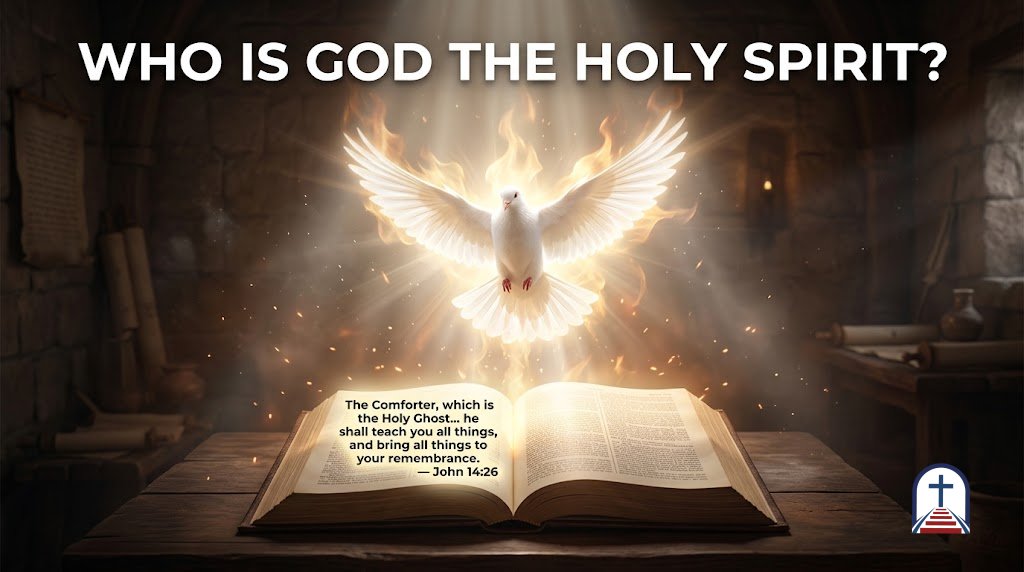
“But the Comforter, which is the Holy Ghost, whom the Father will send in my name, he shall teach you all things, and bring all things to your remembrance, whatsoever I have said unto you.” — John 14:26
A biblically based definition of God the Holy Spirit is that He is the third person of the eternal Trinity, sharing the exact, undivided divine essence with the Father and the Son. He is not an impersonal force or an ethereal energy, but a distinct, fully divine person who convicts the world of sin, regenerates the fallen heart, and permanently indwells believers to comfort, guide, sanctify, and empower them for Christian living and mission.
“God the Holy Spirit is the personal, active presence of God on earth today, who applies the redemptive work of Jesus Christ to the lives of believers, illuminating their minds to understand Scripture and transforming their character to reflect the image of the Son.”
Completing the Picture of the Triune God
In our previous studies for the growing disciple, we established a firm foundation in the doctrine of the Triune Creator. We gazed at the majestic sovereignty of God the Father as the grand architect of creation and redemption, and we marveled at the willing sacrifice of God the Son, the Word made flesh who mediated our salvation. We now complete our exploration of the Godhead by turning our hearts to the third person of the Trinity: God the Holy Spirit.
Many believers find the Holy Spirit to be the most mysterious or misunderstood member of the Trinity. Often, He is wrongly relegated to the background of our faith or viewed merely as a source of emotional experience. However, for a growing disciple, recognizing the person and work of the Holy Spirit is not optional—it is the very breath of the Christian life. Without the Holy Spirit, the Bible remains a closed book, the Christian life remains an impossible standard, and the Church remains a powerless institution.
What Distinguishes the Holy Spirit?
While the Father, the Son, and the Holy Spirit are one God—co-equal in power, glory, and eternity—they possess distinct personal properties and fulfill distinct roles in the divine economy of salvation.
To understand God the Holy Spirit uniquely, we must recognize what sets His personhood and role apart from the Father and the Son:
- Eternal Procession: Theologically, while the Father is unbegotten and the Son is eternally begotten, the Holy Spirit eternally proceeds from the Father and the Son. He is the eternal bond of love between the Father and the Son, sent forth to execute their unified will on earth.
- The Applier of Salvation: In the grand narrative of redemption, the Father plans salvation, the Son accomplishes it on the cross, but it is the Holy Spirit who applies it to the human heart. He is the one who convicts us, brings us to spiritual life (regeneration), and seals us for the day of redemption.
- The Indwelling Presence: The Father reigns from heaven, and the Son is currently seated at the right hand of the Father. It is the Holy Spirit who actually takes up residence within the believer. He is the fulfillment of Christ’s promise not to leave us as orphans, serving as the personal, continuous presence of God inside the life of every Christian.
The Theological Traits of the Holy Spirit
As disciples, our understanding of the Holy Spirit must be anchored in the objective truth of Scripture rather than mere subjective experience. The Bible reveals the Holy Spirit through several key theological traits and undeniable evidence of His divine personhood:
- He is a Divine Person, Not an “It”
The Holy Spirit possesses all the attributes of personhood: intellect, emotion, and will. He can be grieved (Ephesians 4:30), He teaches (John 14:26), He speaks (Acts 13:2), and He distributes spiritual gifts according to His own sovereign will (1 Corinthians 12:11). A growing disciple must learn to relate to the Holy Spirit not as a power to be harnessed, but as a Lord to be obeyed and a friend to be known.
- He is Fully God
The Holy Spirit is not a subordinate being; He is fully God. He is omnipresent (Psalm 139:7-8) and omniscient (1 Corinthians 2:10-11). In Acts 5:3-4, when Ananias lied to the Holy Spirit, the Apostle Peter explicitly stated, “thou hast not lied unto men, but unto God”. He was actively involved in the creation of the universe, hovering over the waters in Genesis 1:2.
- The Divine Author of Scripture
The Holy Spirit is the ultimate author of the Bible. While human authors penned the words, they did so under the direct inspiration of the Spirit. 2 Peter 1:21 declares, “For the prophecy came not in old time by the will of man: but holy men of God spake as they were moved by the Holy Ghost”. Therefore, to understand the Bible, a disciple must rely entirely on the Holy Spirit for illumination (1 Corinthians 2:14).
- The Empowerer for Mission and Ministry
Jesus instructed His early disciples not to attempt the Great Commission in their own strength, but to wait for the Holy Spirit. Acts 1:8 says, “But ye shall receive power, after that the Holy Ghost is come upon you: and ye shall be witnesses unto me both in Jerusalem, and in all Judaea, and in Samaria, and unto the uttermost part of the earth”. He provides spiritual gifts to believers for the edification of the Church and the advancement of the Gospel.
Why Knowing the Holy Spirit is Essential for Discipleship
Understanding the Holy Spirit is not an advanced theological elective; it is central to everyday Christian living. Without a vibrant reliance on the Holy Spirit, discipleship degenerates into exhausting moralism.
- He is the Agent of Sanctification:
We cannot make ourselves holy. The process of sanctification—being conformed to the image of Christ—is a direct work of the Holy Spirit within us (2 Thessalonians 2:13; Romans 8:29). It is the Spirit who produces the “Fruit of the Spirit,” transforming our character to exhibit love, joy, peace, longsuffering, gentleness, goodness, faith, meekness, and temperance (Galatians 5:22-23). - He Provides Assurance of Salvation:
In a world filled with spiritual doubt, it is the Holy Spirit who bears witness with our spirit that we are the children of God (Romans 8:16). He is the “earnest” or down-payment of our eternal inheritance, guaranteeing our future resurrection and glorification. - He Guides and Illuminates Truth:
Because the natural mind cannot receive the things of God, the Holy Spirit acts as our internal teacher. When we read the Bible, it is the Holy Spirit who opens our eyes to see the beauty of Christ and gives us the conviction to apply His Word to our daily challenges (James 1:22).
Next Steps: Engaging with Your S.T.E.P.S. Journey
To ensure this theological truth translates into practical transformation, take the following next steps in your discipleship journey this week:
- Review Your THEOLOGY Assessment: Look at items 20 through 23 on your S.T.E.P.S. Theology Assessment, specifically checking your score on recognizing “the person and work of the Holy Spirit” (John 14:16-17). Identify any gaps in your understanding and ask the Spirit to guide you into all truth.
- Study the Holy Spirit’s Role: Navigate to the “What Every Christian Should Know: The Holy Spirit” section of your S.T.E.P.S. manual. Look up and journal about the essential verses listed, particularly Galatians 5:22-23 (The Fruit of the Spirit) and Acts 1:8 (Power for witness).
- Practice Spiritual Dependency: Before you read your Bible this week, pause and pray for the Holy Spirit’s illumination. Acknowledge that you need His help to understand and apply the Scriptures (1 Corinthians 2:14).