
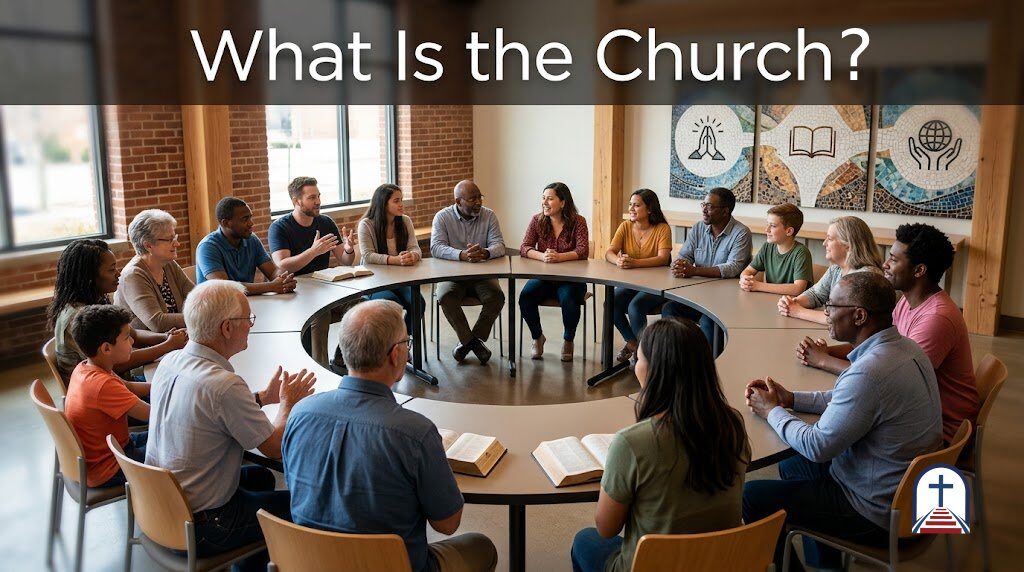
What Is the Church?
If you were to ask someone on the street to define “the church,” they would likely point to a building with a steeple, a cross on the roof, or a sign out front. For many, the church is a location you visit on Sunday morning, a social club with religious overtones, or an institution run by pastors and boards.
However, if we look at the New Testament, we discover a radical truth: the church is never a building, and it is never a place. You cannot “go” to church, because the church is not a destination.
The Greek word used for church in the New Testament is ekklesia, which literally means “an assembly” or “called-out ones.” In the biblical sense, the church is a gathered assembly of people who have been called out of the darkness of the world and called into the light of Jesus Christ.
Whether you are highly active in a local congregation, currently searching for a new church home, or trying to grow your faith independently from the comfort of your own home, understanding God’s design for the church is essential to your growth. Let’s pull up a chair in the Study DEN, open the Scriptures, and look at what the church truly is and why it matters to your discipleship journey.
1. The Two Realities of the Church: Universal and Local
To fully understand the church, theologians look at it through two distinct but deeply connected lenses outlined in Scripture: the universal church and the local church.
-
The Church Universal (The Invisible Church): This consists of every true believer in Jesus Christ across the entire globe, spanning from the Day of Pentecost in the book of Acts until Christ returns. It cuts across denominational lines, geographic borders, and cultural differences. If you have been saved by grace through faith, your name is written in heaven, and you are a member of the universal body of Christ.
-
The Church Local (The Visible Church): This is the local, geographic expression of the universal church. It is a specific group of professing believers who covenant together in a particular city or neighborhood to worship God, study the Scriptures, observe the ordinances, and minister to one another.
While you belong to the universal church the moment you are saved, God’s design is for that reality to be lived out tangibly within a local church community.
2. The Powerful Metaphors of the Church
The New Testament uses vivid, relational imagery to describe the nature and function of the church. These metaphors show us that the church is an organic, living organism rather than an organization.
-
The Body of Christ: The Apostle Paul frequently refers to the church as Christ’s body on earth (1 Corinthians 12). Jesus is the Head, directing the movements, and believers are the individual members. Just like a human body, every member has a different, vital function. A hand cannot do the job of an eye, and an eye cannot do the job of a foot. You have been given specific spiritual gifts that the rest of the body needs to function healthily.
-
The Family (Household) of God: The church is a familial network. God is our Father, Jesus is our elder brother, and we are brothers and sisters in Christ (Ephesians 2:19). This means church isn’t a weekly performance you attend; it is a family table where you belong, share burdens, and support one another through the ups and downs of life.
-
The Temple of the Holy Spirit: In the Old Testament, God’s presence dwelt in a physical building made of stone and gold. In the New Testament, we are the temple. God dwells within the gathered assembly of His people (1 Peter 2:5). We are “living stones” being built together into a spiritual house where God is worshiped.
3. The Functional Mission of the Church
A healthy church doesn’t just exist for its own comfort; it has a clear, divine mandate. When a local church is operating according to biblical design, it will consistently focus on three directions:
Upward: Worship and Prayer
The primary audience of the church is God Himself. The church gathers to exalt the name of Jesus, proclaim His praises, pray collectively, and honor Him through obedience to His Word.
Inward: Discipleship and Edification
The church is an educational and supportive network designed to move believers from “infants in Christ” to mature, multiplying disciples. This involves the preaching of sound theology, regular fellowship, accountability, and the practice of the biblical ordinances (Baptism and the Lord’s Supper).
Outward: Evangelism and Missions
The church is God’s primary vehicle for pushing back the darkness of the world. It exists to declare the Gospel to the lost, care for the hurting and vulnerable, and send out workers to plant new seeds of faith around the country and the world.
Next Steps: Find Your Place in the Network
Discipleship was never meant to be a solo sport. You cannot fully experience the EQUIP or SHARE phases of your spiritual journey in complete isolation. True growth happens when your personal devotion intersects with biblical community.
Whether you are deeply rooted in a local congregation, navigating a transition to a new church family, or utilizing online networks to anchor your faith, it is vital to know where you currently stand in your spiritual development and how you are using your gifts to serve the body.
Step Into the Toolshed:
Ready to see how your understanding of the church and your personal spiritual gifts align? Take action today to clear out the guesswork.
Take our free S.T.E.P.S. Equip Inventory or Share Inventory. These personal evaluation profiles will help you analyze how well you are connecting with the body of Christ, where your specific serving gifts lie, and how you can position yourself to become a multiplying disciple who builds up the church—wherever God has placed you.