Who are the Other Evil Spirits?
“But I say, that the things which the Gentiles sacrifice, they sacrifice to devils, and not to God: and I would not that ye should have fellowship with devils.” — 1 Corinthians 10:20
A biblically based theological definition of “Other Evil Spirits” encompasses the vast array of named demonic entities, territorial rulers, and functionally descriptive spirits that operate within Satan’s kingdom. While we have established general categories of evil spirits, the scriptures also identify specific principalities, ancient false gods, and distinct spirits of influence whose primary function is to draw humanity into idolatry, deception, and systemic rebellion against God.
Continuing the Evil Spirit Beings Series
As we continue our exploration of Evil Spirit Beings within the broader Spirit World series, we have previously examined Lucifer, the general multitude of Fallen Angels, the Angels in Prison, the Spirits in the Abyss, and the ground-level operation of Demons. However, the biblical narrative also addresses specific manifestations and titles of darkness that demand our attention.
To be a fully equipped growing Christian disciple, one must understand that the kingdom of darkness is highly organized and diverse in its operations. By identifying these specific entities and their biblical history, we remove the veil of ignorance and stand more firmly in the ultimate victory and authority of Jesus Christ.
The Pantheon of Darkness: Named Demonic Entities
The Bible occasionally lifts the veil on specific, highly influential evil spirits, revealing their titles and functions within Satan’s hierarchy.
Beelzebub
In the New Testament, the Pharisees accused Jesus of casting out demons by the power of “Beelzebub the prince of the devils” (Matthew 12:24). Historically, this name derives from Baal-Zebub, the ancient Philistine god of Ekron (2 Kings 1:2), meaning “Lord of the Flies.” In Jewish theology, this title became synonymous with Satan himself or one of his highest-ranking commanders. Beelzebub’s function is to oversee the kingdom of demons and promote extreme spiritual uncleanness and rebellion.
Legion
When Jesus encountered the fierce demoniac in the region of the Gadarenes, He asked for the spirit’s name. The response was terrifying: “My name is Legion: for we are many” (Mark 5:9). A Roman legion consisted of up to 6,000 soldiers. This reveals that demons can operate collectively, swarming a single host to cause overwhelming physical strength, self-mutilation, and severe mental torment. It also demonstrates that regardless of their number, an entire legion is instantly subjected to the singular command of Jesus Christ.
Abaddon and Apollyon
As discussed in our previous study on the Spirits in the Abyss, Abaddon (Hebrew for “Destruction”) and Apollyon (Greek for “Destroyer”) is the king over the demonic locusts in the bottomless pit (Revelation 9:11). He represents the apocalyptic, highly restricted judgment forces of darkness that God will temporarily unleash during the end times.
Territorial Spirits and the Gods of Nations
The scriptures reveal that behind the idols and false religions of the ancient (and modern) world exist real, malevolent spiritual entities demanding worship .
Princes of Nations (Territorial Spirits)
In the book of Daniel, chapter 10, the prophet’s prayers are delayed by a spiritual entity known as the “prince of the kingdom of Persia.” The archangel Michael is dispatched to fight this territorial spirit, and later the “prince of Grecia” is mentioned. These are high-ranking principalities assigned by Satan to influence, manipulate, and govern the political and cultural structures of specific geographical nations, promoting laws and cultures that oppose God.
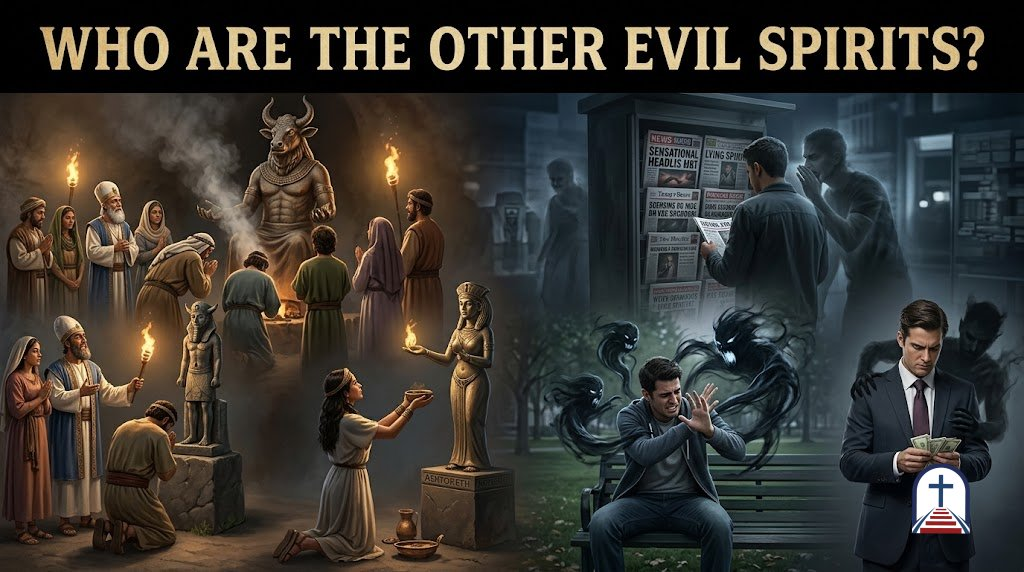
The Old Testament is replete with warnings against the worship of Canaanite deities, which were, in reality, powerful demonic principalities.
- Baal: The supreme god of the Canaanites, worshipped as the provider of rain and fertility. The spirit of Baal demands the compromise of God’s people, seducing them into spiritual adultery and the blending of holy and profane worship (1 Kings 18).
- Ashtoreth (Astarte): Known as the “goddess of the Zidonians” (1 Kings 11:5), Ashtoreth was a prominent Canaanite and Phoenician deity associated with fertility, love, and war. Often worshipped alongside Baal, the demonic entity operating behind Ashtoreth pushed cultures toward extreme moral corruption, sensual idolatry, and licentious practices. The spirit of Ashtoreth represents the weaponization of sexual immorality and cultural perversion to draw believers away from the holiness of God.
- Molech: Perhaps the most wicked of ancient deities, Molech was the god of the Ammonites who demanded horrific child sacrifice (Leviticus 20:2). The spirit behind Molech represents the absolute devaluation of human life and the destruction of the next generation.
- Chemosh: TReferred to in scripture as the “abomination of Moab” (1 Kings 11:7), Chemosh was the national deity of the Moabites. The demonic principality behind Chemosh operated as a fierce territorial spirit that demanded absolute nationalistic devotion and, in times of extreme crisis, horrific blood sacrifice that binds a culture to profound spiritual darkness and violent idolatry. In 2 Kings 3:27, the king of Moab offered his oldest son as a burnt offering upon the wall to appease this entity.
The Gods of the Nations
Psalm 96:5 declares, “For all the gods of the nations are idols: but the LORD made the heavens.” The Apostle Paul later clarifies in 1 Corinthians 10:20 that sacrifices made to these idols are actually sacrifices made to devils (demons). The “gods” of world religions, when they contradict the Gospel of Jesus Christ, are demonic constructs designed to blind the minds of them which believe not (2 Corinthians 4:4).
Spirits of Influence: Architects of Rebellion
The Bible reveals that certain evil spirits function primarily as influencers. Rather than seeking dramatic, physical possession, these entities operate behind the scenes to shape worldviews, corrupt doctrine, and reorient human worship away from God and toward earthly things.
Seducing and Lying Spirits
At the core of Satan’s kingdom is deception, for he is the father of lies. Throughout scripture, we see specific demonic entities tasked with spreading falsehoods. In 1 Kings 22:22, a prophetic vision reveals a “lying spirit” standing before the Lord, offering to deceive King Ahab by filling the mouths of his false prophets with lies. This spirit did not attack Ahab physically; it attacked his perception of truth, leading to his ultimate destruction on the battlefield.
Similarly, the Apostle Paul warns in 1 Timothy 4:1 that in the latter times, people will give heed to “seducing spirits, and doctrines of devils.” These deceiving spirits function specifically to twist scripture, inspire false teachers, and create cultural narratives that directly contradict biblical truth. They are the invisible architects behind destructive ideologies, false religions, and societal shifts that normalize sin.
The Spirit of Mammon
One of the most powerful spirits of influence in our world today is Mammon. In Matthew 6:24, Jesus states a profound spiritual reality: “No man can serve two masters: for either he will hate the one, and love the other; or else he will hold to the one, and despise the other. Ye cannot serve God and mammon.”
Mammon is not merely a synonym for money or currency; Christ personifies it as a rival master, elevating it to the status of a spiritual entity. It is a spirit of greed, materialism, and false security that seeks to replace God as the ultimate provider and the center of a person’s trust. The spirit of Mammon drives modern consumerism, breeds discontentment, and fuels the “love of money,” which the Apostle Paul identifies as the root of all evil in 1 Timothy 6:10. When a culture or an individual becomes obsessed with wealth accumulation and material status, they are yielding to the deceiving spirit of Mammon.
Descriptive Spirits: Identifying the Attack
As we move from cultural influence to personal affliction, we encounter what can be classified as “Descriptive Spirits.” The concept of Descriptive Spirits fits perfectly under the broader category of Deceiving or Lying Spirits, but they are highly specific in their application. While demons often do not give proper names, they are frequently identified in Scripture by the specific lies, sins, or afflictions they push upon humanity.
Named by Function, Not Identity
The Bible frequently mentions spirits by their function or the specific spiritual atmosphere they create. For example:
- A Spirit of Whoredoms: Hosea 4:12 speaks of a “spirit of whoredoms” that caused God’s people to err, blinding them through spiritual and physical prostitution.
- A Spirit of Fear: Paul encourages Timothy by reminding him that “God hath not given us the spirit of fear; but of power, and of love, and of a sound mind” (2 Timothy 1:7).
- A Spirit of Jealousy: Numbers 5:14 describes a “spirit of jealousy” coming upon a man, causing overwhelming suspicion and strife.
- A Spirit of Slumber (Stupor): Romans 11:8 describes a “spirit of slumber” that blinds the eyes and deafens the ears to spiritual truth.
- A Spirit of Heaviness: Isaiah 61:3 speaks of the garment of praise being given for the “spirit of heaviness,” indicating a demonic weight of despair or depression.
- Unclean Spirits: Frequently mentioned in the Gospels, these spirits drive individuals toward moral filth, lust, and degradation.
These titles are not proper names like “Gabriel” or “Michael.” Instead, they are functional descriptions of the demonic entity’s assignment. They aggravate human vulnerabilities, turning natural temptations into overwhelming spiritual bondages.
The Flesh vs. Demonic Influence (Lust, Envy, and Greed)
When discussing sins like lust, envy, and greed, a careful biblical distinction must be made. For the most part, the Bible does not assign proper, individual demonic names to specific sins. The idea of specific named demons for the “Seven Deadly Sins”—such as Asmodeus for lust or Leviathan for envy—comes from much later medieval tradition and extra-biblical literature, not the canonical Bible itself.
Instead, the Apostle Paul usually attributes these drives to the “works of the flesh,” which is the fallen human sinful nature (Galatians 5:19-21). It is vital to understand that not every sin is a demon. However, unclean and descriptive spirits will actively prey upon the works of the flesh. A person may have a natural, fleshly struggle with lust or envy, and an “unclean spirit” or a “spirit of jealousy” will capitalize on that vulnerability, deceiving the believer and fanning the spark of fleshly desire into a raging fire of spiritual bondage.
The Importance of Knowing This for a Growing Disciple
For a growing Christian disciple, understanding this diverse array of evil spirits is deeply practical.
- First, it validates the necessity of the Armor of God. We are not just fighting a vague concept of evil; we are wrestling against highly intelligent principalities, lying spirits, and territorial rulers (Ephesians 6:12). Knowing the enemy’s specific tactics—whether the greed of Mammon or the deception of seducing spirits—allows us to proactively wield the Shield of Faith and the Sword of the Spirit.
- Second, it reveals the absolute supremacy of Jesus Christ. Whether facing a single spirit of heaviness, a territorial prince, or a Legion of thousands, the authority of Jesus is uncontested. He has spoiled principalities and powers, triumphing over them through the cross (Colossians 2:15).
- Finally, it reinforces our call to holiness and discernment. We must guard our hearts against the subtle idolatry of Mammon and the deceiving doctrines of our age, remaining rooted entirely in the truth of God’s Word.
Next Steps for Your Discipleship Journey
To actively engage with this theological truth and stand firm in your spiritual walk, take the following steps this week using your S.T.E.P.S. resources:
- Engage in Spiritual Warfare Training (EQUIP): Revisit the Spiritual Warfare section of your EQUIP manual. Memorize Ephesians 6:10-18. Practice the daily application of “putting on” the Armor of God to protect yourself against lying spirits and the spirit of Mammon.
- Solidify Your THEOLOGY of Essential Doctrines: Review your THEOLOGY evaluation, specifically focusing on the authority of Scripture (Question 17). A strong foundation in biblical truth is your only defense against seducing spirits and doctrines of devils.
- Practice Intercessory Prayer (PRACTICE): Understanding territorial spirits should change how we pray for our cities and nations. Dedicate time this week to pray for your local and national leaders, asking God to bind the influence of dark principalities and to release His truth and light into your community.