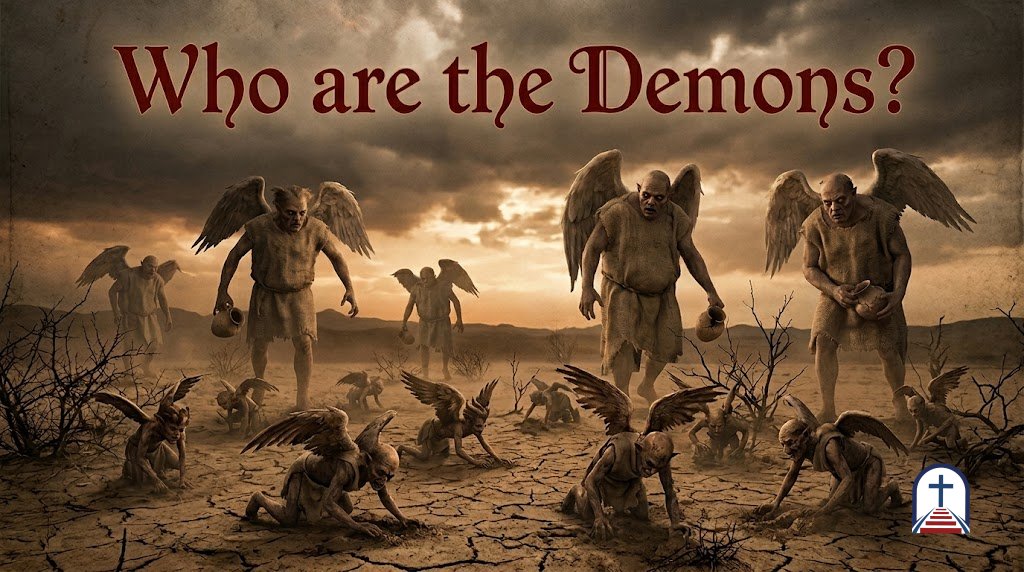
Who are the Demons?
“For we wrestle not against flesh and blood, but against principalities, against powers, against the rulers of the darkness of this world, against spiritual wickedness in high places.” — Ephesians 6:12
A biblically based theological definition of “demons” is that they are malevolent, disembodied evil spirits operating under the dominion of Satan, seeking embodiment to afflict, torment, and deceive humanity. Unlike the higher-ranking principalities and powers that govern atmospheric or territorial realms, demons operate primarily at the ground level of human experience, inflicting spiritual, mental, and physical bondage while fiercely opposing the kingdom of God.
Continuing the Evil Spirit Beings Series
As we progress through our Spirit World series, we have thus far examined Lucifer (the architect of rebellion), the governing Principalities and Powers, and the severely restricted Angels in Prison. We now turn our attention to the foot soldiers of the kingdom of darkness: demons.
While modern culture often uses the terms “fallen angel” and “demon” interchangeably, historical biblical theology presents distinct classifications. Understanding the specific nature, functions, and limitations of demons is crucial for a growing Christian disciple. It demystifies the enemy’s ground-level tactics and highlights the absolute supremacy and authority of Jesus Christ over every unclean spirit.
Origin and History: Are Demons Fallen Angels?
The precise origin of demons has been a subject of deep theological study for centuries. While the Bible does not provide an explicit, singular origin story for demons as it does for the creation of man, two primary theological views exist regarding their origin.
View 1: Synonymous with Fallen Angels
The most common contemporary view asserts that demons are simply the angels who rebelled with Lucifer (Revelation 12:4). In this view, when a third of the angels fell, they were reorganized into Satan’s dark kingdom, with “demon” or “devil” serving as the general term for these rebellious spirits.
View 2: The Spirits of the Nephilim
A second, ancient, and highly influential theological view—held by many early church fathers and rooted in Jewish intertestamental literature—distinguishes between fallen angels and demons. This view points to Genesis 6:1-4, where “the sons of God” (fallen angels) improperly cohabited with the “daughters of men,” producing a hybrid race of giants known as the Nephilim. When God destroyed the bodies of the Nephilim in the global flood, their corrupted, hybrid spirits were left to roam the earth as disembodied entities. In this perspective, fallen angels are celestial beings of immense power (principalities), whereas demons are the desperate, disembodied spirits of the Nephilim cursed to wander the earth seeking physical vessels.
Regardless of which specific theological origin one leans toward, the biblical mandate remains the same: these are entirely evil entities aligned with Satan’s purpose to steal, kill, and destroy (John 10:10).
Detailed Description, Other Names, and Functions
Demons are characterized by their intense wickedness, their intelligence, and their profound desire for embodiment. Because they are spirit beings, they require a physical vessel (human or animal) to fully express their dark desires and interact with the physical world in a sustained manner, as seen when the “Legion” of demons begged Jesus to send them into a herd of swine (Mark 5:12).
Other Biblical Names
Throughout the Bible, demons are referred to by several descriptive titles that reveal their nature:
- Unclean Spirits: This is the most common term used in the Gospels, highlighting their moral filth and their drive to defile whatever they inhabit (Matthew 10:1).
- Familiar Spirits: Often associated with witchcraft and mediumship, these spirits masquerade as deceased loved ones or guides to deceive the living (Leviticus 19:31; 1 Samuel 28:7).
- Devils: In the KJV, the Greek word daimonion is frequently translated as “devils,” denoting their role as accusers and adversaries (James 2:19).
- Spirits of Divination: Spirits that grant supernatural, yet forbidden, knowledge or fortune-telling abilities, such as the spirit cast out by the Apostle Paul in Philippi (Acts 16:16).
Their Primary Functions
The kingdom of darkness operates with malicious intent against God’s creation. Demons execute this through several key functions:
- Affliction and Torment: They inflict severe physical, mental, and emotional torment. In the Gospels, demons are shown causing muteness, deafness, seizures, and severe mental distress (Matthew 9:32-33; Mark 9:17-22).
- Spiritual Bondage and Strongholds: They work to build ideological and emotional fortresses in people’s minds, keeping them enslaved to addictive behaviors, irrational fears, and ungodly belief systems (2 Corinthians 10:4-5).
- Deception and False Doctrine: The Apostle Paul warned that in the latter times, some would depart from the faith, “giving heed to seducing spirits, and doctrines of devils” (1 Timothy 4:1). They are the spiritual architects behind false religions, cults, and cultural deceptions.
Their Subjection to Christ and Ultimate Fate
Despite their malevolence and power over unregenerate humanity, demons are entirely subjected to the authority of Jesus Christ. During His earthly ministry, Jesus effortlessly cast out unclean spirits with a single word. The demons themselves recognized His divine authority and trembled in terror, asking if He had come to destroy them before the appointed time (Matthew 8:29).
At the cross, Jesus decisively disarmed and defeated the powers of darkness. Colossians 2:15 declares, “And having spoiled principalities and powers, he made a shew of them openly, triumphing over them in it”.
Because of Christ’s victory, demons operate on borrowed time. Their ultimate fate is sealed. At the final judgment, every unclean spirit will be cast into the Lake of Fire, which was “prepared for the devil and his angels” (Matthew 25:41). There, they will face eternal, irreversible torment for their rebellion against the Holy God.
The Importance of Knowing This for a Growing Disciple
For a growing Christian disciple, understanding the reality of demons is not meant to inspire fear, but rather to cultivate spiritual vigilance and radical dependence on Jesus Christ.
- First, it illuminates the true nature of our daily struggles. Recognizing that there is an active, invisible enemy seeking to devour us (1 Peter 5:8) shifts our perspective. We realize that our battle is not against our spouse, our neighbor, or our culture, but against the spiritual forces of darkness operating behind them.
- Second, it reveals our need for the Armor of God. We cannot defeat demonic deception with human reasoning or overcome spiritual bondage with mere willpower. We must daily put on the belt of truth, the breastplate of righteousness, the shield of faith, and the helmet of salvation, wielding the sword of the Spirit, which is the Word of God (Ephesians 6:10-18).
- Finally, this knowledge solidifies our identity and authority in Christ. Believers who are indwelt by the Holy Spirit cannot be possessed by demons. “Greater is he that is in you, than he that is in the world” (1 John 4:4). We do not fight for victory over the demonic realm; we fight from the victory already secured by Jesus’ blood.
Next Steps for Your Discipleship Journey
To actively engage with this theological truth and stand firm in your spiritual walk, take the following steps this week using your S.T.E.P.S. resources:
- Engage in Spiritual Warfare Training (EQUIP): Revisit the Spiritual Warfare section of your EQUIP manual. Memorize Ephesians 6:10-18. Practice the daily application of “putting on” the Armor of God through prayer, specifically using the Sword of the Spirit (God’s Word) to actively resist temptations and fearful thoughts.
- Solidify Your THEOLOGY of Christ’s Victory: Review your THEOLOGY evaluation (questions 22 and 25). Dive deeper into the “Essential Doctrines” lesson, focusing on Christology—the person and work of Jesus Christ. Understanding His complete atoning work and triumphant resurrection is your greatest defense against the accuser.
- Implement Focused Prayer and Fasting (PRACTICE): As Jesus noted in Mark 9:29, some spiritual battles require deep dependency on God through prayer and fasting. Commit to a day of fasting this week, praying specifically for the breaking of any spiritual strongholds in your family, community, or church.