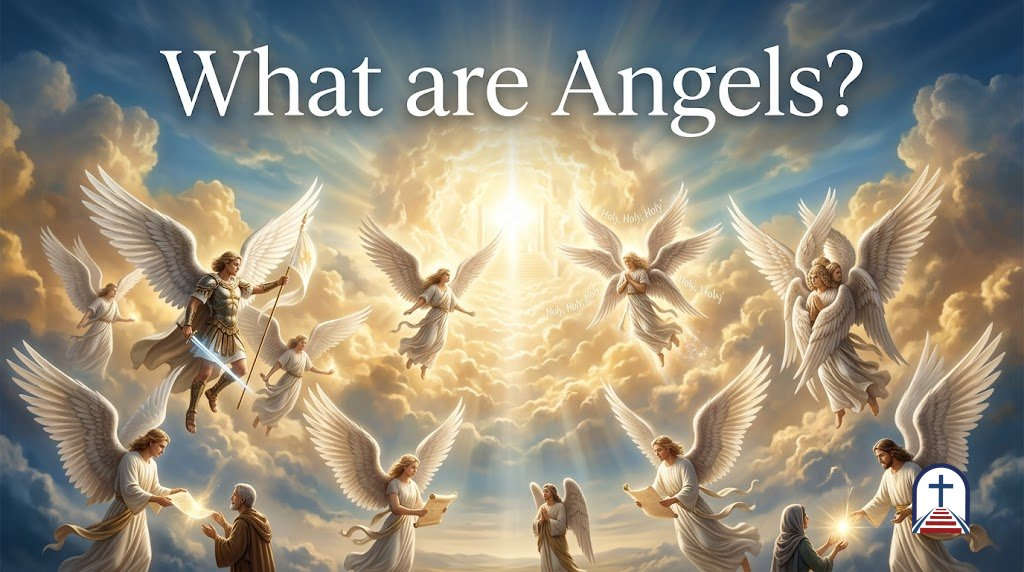
What are Angels?
God’s Heavenly Messengers and Ministers
“Are they not all ministering spirits, sent forth to minister for them who shall be heirs of salvation?” — Hebrews 1:14
A biblically based definition of an angel is a powerful, immaterial, created spiritual being who dwells primarily in the heavenly realms, serving directly under the authority of God. They function as His divine messengers, fierce warriors, and unseen ministers to humanity. Unlike human beings, angels do not possess physical bodies of flesh and blood by nature, though they have the God-given ability to manifest in physical form when specific missions require it.
“Angels are holy, intelligent, and immortal spiritual beings created by the Triune God to ceaselessly worship Him, execute His sovereign will across the universe, and minister to those who are redeemed by the blood of Jesus Christ.”
Continuing Our Journey Through the Spirit World
In our ongoing discipleship series, we recently established a foundational understanding of the unseen spiritual realm. We discovered that reality extends far beyond what our physical eyes can perceive. As we continue to explore the spirit world, we must now turn our attention to the specific inhabitants of this realm, starting with the holy angels.
While pop culture often depicts angels as chubby infants with wings or as humans who have earned their halos after death, the Bible paints a vastly different and infinitely more majestic picture. For a growing disciple, establishing a robust, biblical “angelology” (the study of angels) is not merely an academic exercise; it is vital for understanding how God interacts with His creation and how we are supported in our spiritual journey.
The History and Nature of Angels
To understand angels, we must first look at their origin. Angels are not eternal beings; they have not always existed. Like the heavens and the earth, they are a part of God’s creation.
Created by Christ
The Apostle Paul makes it clear that angels were created by Jesus Christ. Colossians 1:16 declares, “For by him were all things created, that are in heaven, and that are in earth, visible and invisible, whether they be thrones, or dominions, or principalities, or powers: all things were created by him, and for him.” This places angels squarely under the sovereign rule of the Son of God.
Created Before the Earth
While the exact day of their creation is not detailed in Genesis, the Book of Job indicates that the angelic host was already present when God formed the physical universe. God asks Job, “Where wast thou when I laid the foundations of the earth… When the morning stars sang together, and all the sons of God shouted for joy?” (Job 38:4, 7). This reveals that angels have witnessed the entirety of human history.
A Distinct Creation
It is a common misconception that humans become angels when they die. This is unbiblical. Angels and humans are distinct orders of creation. Humans are uniquely created in the image of God (imago Dei) to rule over the earth, whereas angels are entirely spiritual beings created to serve.
The Classes and Levels of Angels
The Scriptures indicate that the angelic realm is highly organized, possessing different ranks, classes, and levels of authority. While the Bible does not give a comprehensive organizational chart, it does reveal distinct types of angels:
1. The Angel of the Lord
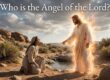
Throughout the Old Testament, there is a unique and specific figure identified as “the angel of the LORD” (as opposed to an angel). This being stands apart from all other angelic classes because He often speaks directly as God, identifies Himself as God, and accepts worship—something regular angels explicitly forbid. For example, the Angel of the Lord appeared to Moses in the burning bush (Exodus 3:2) and to Hagar in the wilderness (Genesis 16). Many biblical scholars believe that “the Angel of the Lord” is a Christophany— a pre-incarnate appearance of Jesus Christ in the Old Testament, serving as the ultimate messenger and representative of the Godhead before His birth in Bethlehem.
2. Archangels
The prefix “arch” means chief or principal. The Bible specifically names Michael as an archangel (Jude 1:9). Archangels appear to be high-ranking leaders of the angelic armies. In Revelation 12:7, we read, “And there was war in heaven: Michael and his angels fought against the dragon.” They possess immense power and authority, leading other angels in spiritual warfare.
3. Seraphim
The Seraphim (meaning “burning ones”) are mentioned in Isaiah 6 during the prophet’s vision of God’s throne room. They are described as having six wings: two to cover their faces, two to cover their feet, and two to fly. Their primary function appears to be the continuous, passionate worship of God’s supreme holiness, crying out, “Holy, holy, holy, is the LORD of hosts: the whole earth is full of his glory” (Isaiah 6:3).
4. Cherubim
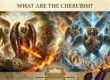
Cherubim are high-ranking angels closely associated with guarding the holiness and glory of God. After the Fall of Adam and Eve, God placed Cherubim at the east of the Garden of Eden with a flaming sword “to keep the way of the tree of life” (Genesis 3:24). The prophet Ezekiel also describes Cherubim in his visions as complex, majestic beings bearing the very throne or chariot of God (Ezekiel 10).
5. Ophanim
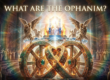
Ophanim, the “wheels within wheels” covered in eyes described in Ezekiel 1 and 10 are sometimes classified as a class of angels in Jewish tradition (outside the Bible). However, in the biblical text itself, they are described more as the animate, Spirit-driven chariot wheels of God’s throne rather than a distinct class of angels like the Cherubim they travel with.
6. The Four Living Creatures
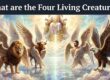
Described by the Apostle John in the book of Revelation, the four living creatures are a majestic and unique class of heavenly beings situated in the center and immediately around the throne of God (Revelation 4:6-8). John describes them as being covered with eyes in front and in back, symbolizing their ever-watchful nature and supreme spiritual insight. Each creature has a distinct appearance: the first is like a lion, the second like a calf (or ox), the third has the face of a man, and the fourth is like a flying eagle. Similar to the Seraphim, they possess six wings. Their primary role is the unceasing worship and declaration of God’s eternal nature and power, crying out day and night without rest, “Holy, holy, holy, Lord God Almighty, which was, and is, and is to come.”
7. Warrior Angels
While many angels serve as messengers or worshipers, the Bible also reveals a vast host of warrior angels who engage in fierce spiritual and physical battles to enforce God’s will. They are the soldiers of the heavenly host. In Daniel 10, an angel is delayed by a demonic entity known as the “prince of the kingdom of Persia” until Michael, a chief prince, comes to help him fight. In 2 Kings 6, the prophet Elisha prays for his servant’s eyes to be opened, revealing that the surrounding hills are filled with invisible warrior angels and horses and chariots of fire, ready to defend them against the Syrian army.
8. Guardian Angels
Scripture strongly indicates that God assigns specific angels to protect, guide, and minister to individuals, often referred to as guardian angels. Psalm 91:11-12 promises, “For he will command his angels concerning you to guard you in all your ways.” Jesus also highlighted the protective, deeply connected nature of these angels when speaking about children in Matthew 18:10, warning people not to despise little ones, “For I tell you that in heaven their angels always see the face of my Father who is in heaven.” Hebrews 1:14 further describes angels as “ministering spirits sent out to serve for the sake of those who are to inherit salvation.”
9. Ministering (or Comforting) Angels
While similar to Guardian Angels, Ministering Angels serve a specific function of providing physical, emotional, and spiritual sustenance to God’s people during times of intense weakness, trial, or grief. After Jesus endured forty days of temptation by Satan in the wilderness, the Bible says, “angels came and were ministering to him” (Matthew 4:11). Similarly, in the Garden of Gethsemane, as Jesus agonized over His impending crucifixion, “there appeared to him an angel from heaven, strengthening him” (Luke 22:43). They act as God’s divine caretakers for the weary.
10. Messenger Angels
The Greek word angelos and the Hebrew word malak both literally translate to “messenger.” Delivering God’s divine decrees and revelations to humanity is one of the most common angelic functions seen in Scripture. The angel Gabriel is the most prominent example of a messenger angel. He was entrusted with delivering some of the most critical announcements in biblical history, including explaining complex visions to the prophet Daniel in the Old Testament, and announcing the miraculous births of John the Baptist to Zacharias and Jesus Christ to the Virgin Mary in the New Testament (Luke 1:19, 26).
11. The Watchers (or Holy Ones)
In the book of Daniel, King Nebuchadnezzar has a vision where he hears a decree from a specific class of heavenly beings called “watchers” or “holy ones.” Daniel 4:17 says, “The sentence is by the decree of the watchers, the decision by the word of the holy ones…” These beings appear to be angelic sentinels or observers who patrol the earth, monitor human affairs, and act as a heavenly council that watches over earthly kings and kingdoms to ensure that God’s sovereign will is carried out among mankind.
12. The Destroying (or Judgment) Angels
While angels are often associated with protection and good news, the Bible also reveals that God uses specific angels to execute His divine judgment and wrath. In Exodus 12:23, a “destroyer” (often understood as an angel of judgment) strikes down the firstborn of Egypt. In 2 Samuel 24:16, an angel stretches out his hand to destroy Jerusalem after David’s sin of taking a census. Throughout the book of Revelation, angels are the primary agents who pour out the bowls of God’s wrath and blow the trumpets of judgment upon the earth. These angels demonstrate God’s holy justice and His power over sin and rebellion.
The Functions of Angels in the Biblical Narrative
Angels are not passive observers; they are highly active in the execution of God’s purposes across the redemptive narrative.
- Ceaseless Worship: As seen with the Seraphim, a primary role of the angelic host is the continuous worship and glorification of God the Father and God the Son (Revelation 5:11-12).
- Delivering Divine Messages: They act as God’s heralds, announcing major events in the history of redemption, such as the birth of Christ (Luke 2:9-14) and His resurrection (Matthew 28:5-7).
- Ministering to Believers: Angels are sent to encourage and sustain God’s people. They ministered to Jesus after His temptation in the wilderness (Matthew 4:11) and delivered Peter from prison (Acts 12:7).
- Executing Divine Judgment: Angels are powerful warriors who carry out God’s holy justice. In the Old Testament, an angel struck down the Assyrian army (2 Kings 19:35), and the Book of Revelation depicts angels pouring out the bowls of God’s wrath upon the earth in the end times (Revelation 16).
The Importance of Knowing About Angels for a Disciple
Why should a growing disciple study angels? Understanding this doctrine provides immense practical and spiritual benefits:
1. It Fosters Comfort and Courage
Knowing that God commands armies of powerful spiritual beings who are actively “sent forth to minister for them who shall be heirs of salvation” (Hebrews 1:14) provides profound comfort. When we face severe trials or intense spiritual warfare, we can rest assured that God’s unseen forces are actively working on our behalf, just as they did for Elisha (2 Kings 6:16-17).
2. It Prevents Idolatry and Error
A biblical understanding of angels protects believers from the dangerous error of angel worship. The Apostle Paul explicitly warned against this in Colossians 2:18. When the Apostle John fell at the feet of an angel to worship him, the angel immediately rebuked him: “See thou do it not: for I am thy fellowservant… worship God” (Revelation 22:9). Angels are our fellow servants; they are never to be prayed to or worshipped.
3. It Highlights the Supremacy of Christ
The entire first chapter of Hebrews is dedicated to proving that Jesus Christ is infinitely superior to the angels. Angels are servants; Jesus is the Son. Angels worship; Jesus is worshipped. Studying the majesty of angels should ultimately lead us to greater awe of Jesus Christ, who rules over them all.
Next Steps: Engaging with Your S.T.E.P.S. Journey
To ensure this theological understanding shapes your daily discipleship, take the following next steps this week:
- Review Your THEOLOGY Assessment: Revisit the section on “God’s Nature and Character” (Topic 1). Reaffirm your belief in God’s omnipotence and sovereignty over all creation, including the invisible realm of angels (Colossians 1:16).
- Study Spiritual Warfare: In the “Facing Challenges in the Christian Life” section of your S.T.E.P.S. manual, review the topic of Spiritual Warfare (Topic 11). Remember that while holy angels fight for us, we are called to actively put on the full armor of God to stand against fallen angels (Ephesians 6:10-18).
- Deepen Your Worship: Angels ceaselessly worship God. Use your practice of daily prayer (Topic 9) to emulate the Seraphim. Spend time today doing nothing but praising God for His holiness, justice, and mercy, joining your voice with the heavenly host (Isaiah 6:3).