
What is the Underworld?
Realms of the Dead and Demonic Prisons
“I am he that liveth, and was dead; and, behold, I am alive for evermore, Amen; and have the keys of hell and of death.” — Revelation 1:18
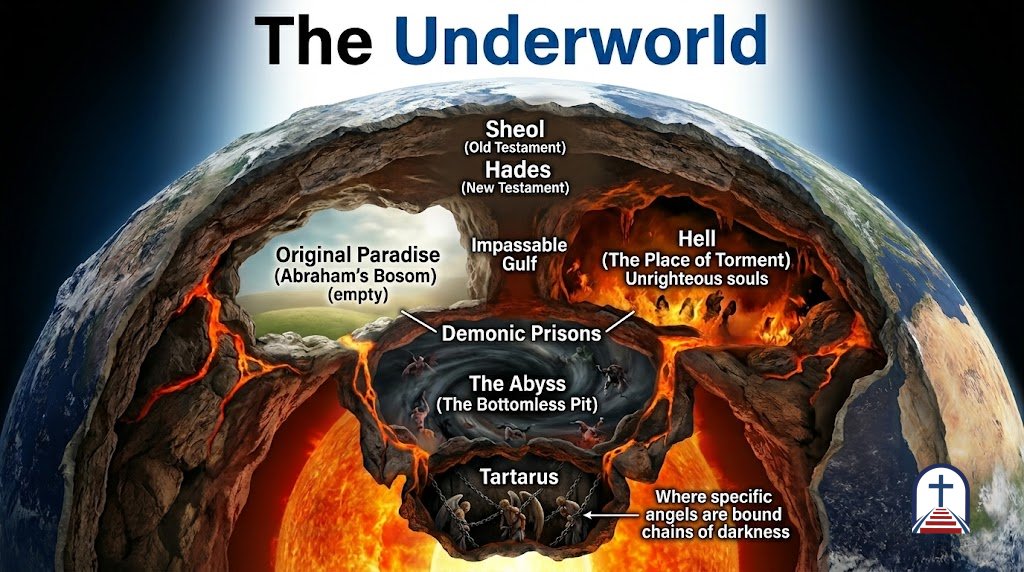
A biblically based theological definition of the Underworld describes it as the temporary spiritual realm that exists prior to the final judgment, serving as the dwelling place for the souls of the departed and as a prison for specific rebellious spiritual beings. In biblical terminology, the overarching terms for this realm are Sheol in the Old Testament and Hades in the New Testament. It is not the final, eternal destination for either the righteous or the wicked, but rather a temporary holding realm categorized into distinct compartments based on righteousness, wickedness, and divine judgment.
For the growing Christian disciple, understanding the Underworld is vital. It highlights the stark reality of life after death, the severe consequences of humanity’s separation from God because of sin, and the absolute triumph of Jesus Christ over death and the grave.
Understanding Sheol and Hades: The Overarching Terms
Throughout the Bible, the terms Sheol (Hebrew) and Hades (Greek) are used to describe the general realm of the dead.
- Sheol: In the Old Testament, Sheol is often translated as “the grave,” “the pit,” or “hell.” It was understood as the place where all souls went upon physical death, a realm of shadows beneath the earth.
- Hades: In the New Testament, Hades is the Greek equivalent of Sheol.
Before the resurrection of Jesus Christ, Sheol/Hades was universally the destination for all departed human souls. However, it was not a uniform realm; it was deeply divided based on an individual’s relationship with God.
The Compartments of the Underworld for Human Souls
Based on the teachings of Jesus, particularly the historical account or parable of the rich man and Lazarus in Luke 16:19-31, we see that Sheol/Hades was divided into two distinct compartments separated by an impassable gulf.
Original Paradise (Abraham’s Bosom)
This was the compartment of comfort and rest for the righteous dead—those who died in faith, looking forward to the promise of the Messiah.
- Description and Purpose: Jesus referred to this place as “Abraham’s bosom” (Luke 16:22). It was a place of conscious comfort where the Old Testament saints awaited the culmination of God’s redemptive plan.
- Location: It was situated within the overarching realm of Sheol/Hades but separated entirely from the place of torment.
- Current Status: Ephesians 4:8-9 indicates that when Christ ascended, He “led captivity captive.” It is widely understood by theological scholars that upon His resurrection, Jesus emptied this compartment, taking the righteous souls into the presence of God in the third heaven. Therefore, Abraham’s Bosom is currently empty.
Hell (The Place of Torment)
In the context of the Underworld, “Hell” (often translated from the Greek word Hades when referring to the wicked side) refers to the temporary place of conscious torment for the unrighteous dead.
- Description and Purpose: In Luke 16:23-24, the rich man is described as being in “torments” and longing for a drop of water to cool his tongue in the flame. It is a place of suffering, regret, and separation from God’s grace for those who rejected Him in life.
- Location: This is the other side of Sheol/Hades, separated from Abraham’s Bosom by a “great gulf fixed” (Luke 16:26).
- Current Status: It remains the temporary holding place for the souls of the unrighteous until the end of the age. At the final judgment, death and Hades (Hell) will deliver up the dead in them to stand before the Great White Throne, after which they will be cast into the eternal Lake of Fire (Revelation 20:11-15).
The Demonic Prisons
The Underworld is not only for human souls; it also contains specific maximum-security prisons designed for rebellious angelic and demonic beings.
The Abyss (The Bottomless Pit)
The Abyss (or bottomless pit) is a deep, dark spiritual prison used to temporarily confine certain highly destructive demonic entities.
- Description and Purpose: It is a place of confinement rather than immediate torture, keeping powerful evil spirits from wreaking havoc on the earth until God’s sovereign timing permits. In Luke 8:31, the demons possessing the man in Gadara begged Jesus not to send them “out into the deep” (the Abyss).
- Biblical Role: In Revelation 9, the Abyss is temporarily opened, releasing a horde of demonic “locusts” upon the earth. Later, in Revelation 20:1-3, Satan himself is bound and cast into the bottomless pit for a thousand years during Christ’s millennial reign.
Tartarus
Tartarus is the deepest, darkest realm of the Underworld, reserved exclusively for a specific group of fallen angels.
- Description and Purpose: Mentioned only once in the New Testament (2 Peter 2:4), Tartarus is the prison where God cast the angels that sinned, delivering them “into chains of darkness, to be reserved unto judgment.”
- Biblical Context: Jude 1:6 also describes these beings as the angels who “kept not their first estate, but left their own habitation.” This is widely associated with the “Watchers” (fallen angels) who committed grievous sins involving human women in the days of Noah (Genesis 6). They are permanently chained in Tartarus until the final judgment, unable to roam the earth or the heavens.
The Importance of Knowing This for a Growing Disciple
Studying the Underworld is not meant to incite fear in the believer, but rather to ground us in biblical reality and doctrinal truth.
- It Highlights the Urgency of Salvation: Knowing the reality of Hell as a place of torment for those separated from God underscores the critical necessity of salvation by grace through faith in Christ (Ephesians 2:8-9). It should ignite a passionate urgency to fulfill the Great Commission and share the Gospel.
- It Validates Christ’s Absolute Victory: Jesus holds the “keys of hell and of death” (Revelation 1:18). By understanding the structure of Sheol/Hades, we see the magnitude of Christ’s resurrection. He conquered the grave, leading the righteous captives to heaven and ensuring that believers will never experience the torments of the Underworld.
- It Provides Clarity on Spiritual Warfare: Recognizing that God has already imprisoned highly dangerous rebellious angels (Tartarus) and commands the Abyss proves that He is sovereign over all dark forces. We can engage in spiritual warfare knowing that our Enemy is ultimately defeated and operates only within God’s set boundaries.
Next Steps for Your Discipleship Journey
To practically apply this theological understanding to your spiritual growth, consider these next steps:
- Deepen Your Gratitude (PRACTICE): Spend time in your daily prayer specifically thanking Jesus for His atoning death and resurrection. Express gratitude that because of His sacrifice, your eternal destination is secure, and you will never face the separation of the Underworld.
- Study the Final Judgment (THEOLOGY): To distinguish between the temporary Underworld and the eternal state, read Revelation 20:11-15. Note the difference between “death and hell [Hades]” giving up their dead, and the final destination of the “lake of fire.” This will solidify your eschatology (doctrine of last things).
- Share the Hope of the Gospel (SHAPE): Let the reality of eternal separation motivate you to reach out to the lost. Identify three people in your life who do not know Christ and commit to praying for them daily, asking the Holy Spirit for opportunities to share the hope of salvation with them.