What are the Heavens?
The Realm of God and Light
“I knew a man in Christ above fourteen years ago, (whether in the body, I cannot tell; or whether out of the body, I cannot tell: God knoweth;) such an one caught up to the third heaven.” — 2 Corinthians 12:2
A biblically based theological definition of “The Heavens” requires us to expand our understanding beyond the physical sky we see every day. In Christian theology, the heavens represent the present, upward spiritual realms where the unshielded glory of God is fully manifested and where the spirits of believers go upon death. Scripturally, heaven is not a nebulous, floating state of mind, but a concrete, layered reality—a literal realm characterized by divine light, perfect holiness, and the absolute sovereign presence of God.
For the growing Christian disciple, establishing a robust theology of the heavens is not merely an academic exercise. It is a vital component of spiritual maturity that anchors our faith, providing absolute assurance that our prayers enter a real sanctuary and that our ultimate citizenship is secured in a real, unshakable city.
The Structure of the Heavens: A Three-Tiered Reality
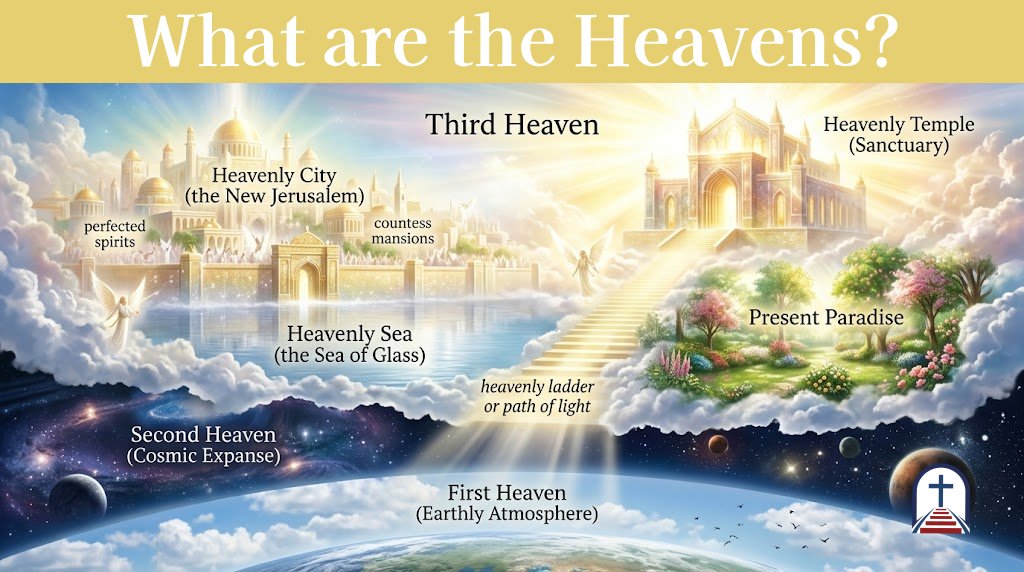
When the Bible speaks of “heaven,” it does not always refer to the eternal dwelling place of God. The Scriptures present a multifaceted view of the heavens, generally categorized into three distinct layers or realms. Understanding this three-tiered structure is essential for proper biblical interpretation and for grasping the full scope of God’s creation.
The First Heaven: The Earthly Atmosphere
The first heaven is the immediate, visible realm that surrounds the earth. It is the atmosphere where weather occurs, where clouds gather, and where the birds fly.
- Biblical Evidence: In Genesis 1:20, the Scripture states, “And God said, Let the waters bring forth abundantly the moving creature that hath life, and fowl that may fly above the earth in the open firmament of heaven.”
- Theological Purpose: This realm sustains physical life on earth. It is a daily, visible testament to God’s common grace, providing the air we breathe and the rain that waters the ground. It is the closest and most tangible aspect of the “heavens” to human experience.
The Second Heaven: The Cosmic Expanse
The second heaven extends beyond our earthly atmosphere into what we commonly call outer space. It is the vast, staggering expanse of the physical universe, containing the sun, the moon, the planets, the stars, and the galaxies.
- Biblical Evidence: The Psalmist reflects on this specific realm in Psalm 8:3, writing, “When I consider thy heavens, the work of thy fingers, the moon and the stars, which thou hast ordained.”
- Theological Purpose: The second heaven exists to declare the infinite power, majesty, and glory of the Creator. As Psalm 19:1 proclaims, “The heavens declare the glory of God; and the firmament sheweth his handywork.” The sheer scale of the cosmos is designed to humble humanity and point us to the limitless nature of the God who spoke it all into existence.
The Third Heaven: The Invisible Spiritual Realm
The third heaven is the unseen spiritual dimension that exists outside of our physical time and space. This is the ultimate “Realm of God and Light.” It is the throne room of the Almighty, the headquarters of the angelic host, and the current dwelling place of the righteous departed.
- Biblical Evidence: The Apostle Paul provides the most direct reference to this realm in 2 Corinthians 12:2, describing a profound visionary experience where he was “caught up to the third heaven.”
- Theological Purpose: Unlike the first and second heavens, which will eventually pass away and be recreated (Revelation 21:1), the third heaven is the center of divine authority. It is the place of perfect holiness where sin, corruption, and decay have no entry. It is the ultimate reality from which God governs the universe.
Present Paradise: The Abode of the Righteous Dead
A common and profound question among growing disciples is: “Where do believers go immediately after they die?” The biblical answer is found in the theological concept of the intermediate state, specifically identifying the believer’s current destination as “Present Paradise,” which is now synonymous with the Third Heaven. To fully grasp this, one must understand the eschatological shift that occurred following the death, resurrection, and ascension of Jesus Christ.
Prior to Christ’s resurrection, Paradise was located in a compartment of the Underworld. When Jesus was crucified, He offered a profound promise to the repentant thief hanging beside Him. In Luke 23:43, Jesus declared, “Verily I say unto thee, To day shalt thou be with me in paradise.” However, upon His death, Christ did not immediately ascend to the highest heaven. Rather, as He prophesied in Matthew 12:40, just as Jonah was three days and three nights in the belly of the great fish, so the Son of Man would be three days and three nights in the “heart of the earth.” Christ descended into the Underworld—specifically to the compartment of comfort known as “Abraham’s Bosom” (Luke 16:22)—which served as the temporary Paradise for Old Testament saints awaiting the Messiah’s atoning work.
While in the Underworld, Christ declared His triumphant victory to the spirits in prison. He conquered death, securing the “keys of hell and of death” (Revelation 1:18). In doing so, He effectively emptied this subterranean Paradise. The Gospel of Matthew records the immediate physical evidence of this triumph: upon His death, the graves were opened, and many bodies of the saints who had slept arose, waiting to emerge until after Christ’s own resurrection (Matthew 27:52-53). On resurrection morning, Jesus instructed Mary Magdalene not to hold onto Him, stating, “I am not yet ascended to my Father” (John 20:17). When He subsequently ascended, the Scriptures declare that “he led captivity captive” (Ephesians 4:8), leading this train of liberated Old Testament saints—the firstfruits of the resurrection—into the heavenly realm.
Through this triumphant ascension, Christ relocated Paradise from the Underworld to the presence of God in the Third Heaven. This geographical shift in the spirit realm is explicitly confirmed by the Apostle Paul, who uses the terms interchangeably. In 2 Corinthians 12:2-4, Paul describes his experience of being caught up to the Third Heaven, stating: “How that he was caught up into paradise, and heard unspeakable words, which it is not lawful for a man to utter.” Because Christ is currently seated at the right hand of the Father, Paradise is now located wherever He dwells. This establishes the present reality for the New Testament believer, anchored by Paul’s declaration in 2 Corinthians 5:8: “We are confident, I say, and willing rather to be absent from the body, and to be present with the Lord.”
Consequently, for the justified believer, physical death is emphatically not a state of “soul sleep” or unconsciousness. We see abundant evidence of this in the Book of Revelation, which depicts the saints as highly active in Heaven before the final, general resurrection. They are seen crying out to God (Revelation 6:9-10), singing and praising, preparing for the Marriage Supper of the Lamb (Revelation 19:7), and ultimately preparing to return and reign with Christ during the Millennial Kingdom. Therefore, the moment a believer passes from this physical life, their spirit immediately enters the relocated Paradise—the blissful, conscious presence of God in the Third Heaven—where they reside in perfect peace, awaiting the future bodily resurrection that will occur at the end of the age.
The Heavenly Architecture: Temple, City, and Sea
The Scriptures reveal that the Third Heaven is not an empty void of floating spirits. It contains distinct, literal spiritual structures that serve specific functions in God’s redemptive plan.
The Heavenly Sanctuary
The earthly tabernacle built by Moses in the Old Testament, and the subsequent temples in Jerusalem, were not original designs. They were physical, earthly copies of a pre-existing spiritual reality.
- Hebrews 8:5 states that the earthly priests “serve unto the example and shadow of heavenly things, as Moses was admonished of God when he was about to make the tabernacle: for, See, saith he, that thou make all things according to the pattern shewed to thee in the mount.”
- Hebrews 9 further describes this literal, functional spiritual sanctuary in heaven. It is into this perfect, heavenly Holy of Holies that Jesus Christ entered as our ultimate High Priest, presenting His own blood to secure our eternal redemption. Knowing this provides the disciple with the unshakable confidence that our intercessor operates in a flawless, eternal temple.
Mount Zion and the Heavenly Jerusalem
In addition to a sanctuary, the Third Heaven contains a magnificent spiritual city.
- Hebrews 12:22-23 describes this present reality: “But ye are come unto mount Sion, and unto the city of the living God, the heavenly Jerusalem, and to an innumerable company of angels, To the general assembly and church of the firstborn, which are written in heaven, and to God the Judge of all, and to the spirits of just men made perfect.”
- This Heavenly Jerusalem is currently located in the Third Heaven. It is a city of unimaginable joy, filled with the angelic host and the perfected spirits of believers. According to Revelation 21, at the culmination of human history, this very city—the New Jerusalem—will descend from the spiritual heavens down to the physical, recreated New Earth, merging the realms of God and humanity forever.
The Heavenly Sea (The Sea of Glass)
When mapping out the geography of the heavens, we must also account for the majestic “Sea” located directly before the throne of God. While the earthly sea is often associated with chaos, the abyss, and the underworld, the heavenly sea represents absolute purity, peace, and the unapproachable majesty of the Creator.
- Biblical Evidence: In Revelation 4:6, the Apostle John describes his vision of the Third Heaven: “And before the throne there was a sea of glass like unto crystal: and in the midst of the throne, and round about the throne, were four beasts full of eyes before and behind.”
- Theological Purpose: The “Sea of Glass” is a profound feature of the heavenly realm. In Genesis 1:7, God separated the “waters which were under the firmament from the waters which were above the firmament.” This crystalline sea in heaven represents the upper waters, completely calmed and solidified like glass, reflecting the glory of God. It stands as a physical separation between the absolute holiness of the throne and the rest of creation. Unlike the earthly sea, which represents turmoil, storms, and death—and which will be no more in the New Creation (Revelation 21:1)—the heavenly sea is a beautiful, tranquil expanse of worship and divine majesty.
The Importance of Knowing This for a Growing Disciple
Why must a disciple study the spiritual geography of the heavens? Because our theology dictates our reality, and our understanding of the unseen world directly impacts our daily Christian living.
- It Anchors Our Hope: Understanding that the Third Heaven and Paradise are real, literal places removes the fear of death. It assures us that our departed loved ones in Christ are currently experiencing conscious joy in the presence of God.
- It Elevates Our Worship: Knowing that our prayers enter a literal heavenly sanctuary where Christ intercedes for us transforms our prayer lives from a religious duty into a profound, cosmic interaction with the Creator.
- It Cultivates an Eternal Perspective: When we comprehend the staggering reality of the Heavenly Jerusalem, the temporary struggles, persecutions, and material pursuits of this present world lose their grip on our hearts. We learn to “walk by faith, not by sight” (2 Corinthians 5:7), recognizing that our true citizenship is in heaven.
Next Steps for Your Discipleship Journey
Growing in faith is a lifelong, deliberate pursuit. To further cultivate your understanding of the spiritual realms and expand your spiritual maturity within the broader discipleship ecosystem, consider taking the following next steps:
- Engage with the SHAPE Inventory (Salvation & Holiness): Review the SHAPE section of your S.T.E.P.S. manual. Reflect on the doctrine of salvation as the only authorized entry point into the Heavenly Realm. Evaluate how the reality of a perfect, holy heaven should inspire you to pursue personal holiness and sanctification in your daily life, setting yourself apart for God’s purposes.
- Deepen Your Theological Framework (THEOLOGY): Spend time this week studying the essential doctrines of Christ’s resurrection and ascension. Read Hebrews chapters 8 and 9 to deepen your understanding of the Heavenly Sanctuary and Christ’s current role as our High Priest. Ensure your beliefs are grounded in the infallible Word of God rather than cultural myths about the afterlife.
- Cultivate an Eternal Focus (PRACTICE): This week, intentionally align your daily practices with your heavenly citizenship. Since Jesus taught us to pray, “Thy will be done in earth, as it is in heaven” (Matthew 6:10), examine your prayer journal and your daily stewardship. Are you living for the temporary treasures of the first heaven, or are you investing in the eternal realities of the third heaven? Use your local church community to build accountability in keeping your mind set on things above.